If you have found yourself staring at a screen, typing random words like “cat,” “sky,” or “computer” into a search bar while an AI judges you silently, welcome to the club. You are playing Contexto, the word game that has taken the internet by storm. Unlike traditional word games like Wordle, which care about spelling, Contexto is obsessed with meaning. It is a thrilling, sometimes frustrating, race to find the contexto answer by figuring out how the AI thinks.
The premise is deceptively simple: you guess words, and the game ranks them based on how contextually similar they are to the secret word of the day. But here is the catch—you aren’t guessing letters; you are guessing vibes. The game uses a complex machine-learning algorithm trained to understand linguistic relationships. Finding the contexto answer requires you to stop thinking like a human and start thinking like a database of human language. In this guide, we are going to break down exactly how to beat the machine, offering advanced strategies, daily hints, and the logic you need to turn those red bars into a glorious green number one. Whether you are a beginner or a seasoned pro looking for the fastest route to the contexto answer, you have come to the right place.
Understanding the Algorithm: How Contexto Thinks
To consistently find the correct contexto answer, you first need to understand what is happening behind the curtain. Contexto isn’t a dictionary; it is a “word embedding” model. Essentially, the game has read a massive amount of text (books, articles, websites) and plotted words in a multi-dimensional space. Words that often appear in similar sentences sit closer together. For example, “king” and “queen” are neighbors, while “king” and “apple” are lightyears apart.
When you submit a guess, the AI measures the “cosine similarity” between your word and the secret word. The lower the number, the closer you are to the contexto answer. The higher the number (like 1,500 or more), the more the AI thinks you are talking about a different topic entirely. This explains why you can guess “automobile” and get a rank of 200, but guess “speed” and drop to 2,000. The secret word might be “race,” which relates to both, but the algorithm prioritizes thematic links. Understanding this spatial relationship is the first step toward finding the contexto answer faster than ever before .
The Golden Rules of Starting Strong
Many players sabotage their run immediately by guessing random nouns like “zebra” or “quantum physics.” While those are valid words, they are low-probability plays. To narrow down the contexto answer efficiently, you need a starter strategy.
Start with broad, high-frequency categories. The goal of the first five guesses isn’t to win; it is to map the terrain. If you guess “Object,” “Person,” “Place,” “Idea,” and “Action,” you will quickly see which dimension the contexto answer lives in . If “Object” ranks at 400 and “Person” ranks at 2,000, you immediately know you are looking for a tangible thing, not a celebrity.
Another pro tip for finding the contexto answer is to use “Thing.” This is arguably the most neutral, high-level noun in the English language. If “Thing” ranks poorly, you might be dealing with an abstract concept. If it ranks well, you know the answer is a physical item. This diagnostic approach saves you from wandering down the wrong rabbit hole for twenty minutes.
The Color Code: Reading the Signal
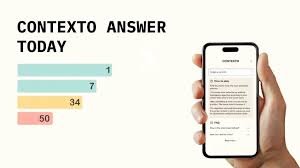
The visual feedback in Contexto is your roadmap to the contexto answer. Do not ignore the colors; they are the only conversation you get to have with the AI. The game typically uses a traffic light system, though the exact thresholds can vary slightly depending on updates .
Understanding these zones is critical. If your guess is deep red (say, rank 1,800), you are in the wrong neighborhood. The contexto answer has nothing to do with your current train of thought. You need to pivot completely. If you are in the orange zone (300 to 1,500), you are in the right book but on the wrong page. You are conceptually adjacent to the contexto answer, but you haven’t hit the specific vocabulary word yet.
The green zone is where magic happens. Once you crack the top 100, you are basically holding the contexto answer in your hands, you just need to refine it. For example, if you are in the top 50 and the word “Mug” appears, you know the secret word is likely “Cup,” “Glass,” “Bottle,” or the eventual contexto answer, “Canteen” . The green zone is about splitting hairs between synonyms.
The “Verb vs. Noun” Trap
One of the most common frustrations for players searching for the contexto answer is the verb/noun paradox. In human language, “run” (the action) and “run” (a score in cricket) are the same word. In Contexto’s AI, they are often treated as distinct vectors depending on usage frequency.
If you are struggling to find the contexto answer, try changing the grammatical form of your guesses. If “Run” isn’t working, try “Runner” or “Running.” Because the AI is trained on text, sometimes the noun form of a verb sits much closer to the secret contexto answer than the verb form does. For instance, if the answer is “Marathon,” the word “Runner” will rank infinitely higher than the word “Sprint,” even though they are conceptually similar. Do not be afraid to add suffixes to your guesses to see if the AI responds better to a specific part of speech .
Contexto Answer for Today: Hints and Solutions
When you are down to your last nerve and the ranks aren’t moving, it is time to look for hints. We do not want to just give away the contexto answer immediately because that ruins the fun, but we can steer you in the right direction.
Let us look at a hypothetical scenario based on a recent high-difficulty puzzle where the contexto answer was “Canteen” . Many players got stuck because they were thinking too narrowly.
Hints to get there:
- Hint 1: It is something you would take on a hike.
- Hint 2: It can refer to a place where soldiers eat.
- Hint 3: It holds water, but it isn’t a bottle.
If you were stuck on “Bottle” (rank 5) or “Flask” (rank 2), the AI was screaming at you that you were close, but you needed to be more specific. The jump from “Bottle” to the contexto answer “Canteen” requires you to think about context—specifically, military or outdoor survival contexts. This illustrates perfectly why the game is called Contexto. It is not just about what the object is, but where it is found.
Advanced Search: The Associative Leap
Intermediate players find the contexto answer by association; advanced players find it by “leaping.” This technique involves guessing a word that bridges two distinct concepts.
Suppose your top words are “Court” (rank 45), “Judge” (rank 50), and “Ball” (rank 60). You have two clusters: legal and sports. The contexto answer likely bridges these two worlds. A word like “Tennis” might be the link (Tennis Court, Tennis Ball), or a word like “Verdict” (which doesn’t fit sports). In this case, the contexto answer might be “Foul”—a word used in basketball (sports) and a term for a violation (legal). By guessing a bridge word, you leap across the semantic gap. If the number drops drastically, you know you have found the thematic core of the contexto answer.
Why Context is King (And Queen)
The name “Contexto” is a direct reference to “context,” specifically the linguistic theory that “a word is characterized by the company it keeps.” This is why some seemingly obvious guesses fail. If the contexto answer is “Star,” guessing “Sun” might rank very high. But guessing “Celebrity” might rank even higher, depending on the dataset.
The algorithm doesn’t know that a star is a ball of gas; it knows that in millions of sentences, the word “star” appears next to “famous,” “actor,” and “Hollywood” just as often as it appears next to “galaxy” and “telescope” . To win, you have to play the odds. When you are hunting for the contexto answer, always ask yourself: “In what situation is this word most commonly used?” If you guess “Keyboard,” but the answer is “Piano,” you are solid. If the answer is “Computer,” you are also solid. But if the answer is “Typing,” you might be rank 1. You need to find the central hub of that specific semantic web.
Tools of the Trade: Using Word Lists
While brute-forcing every word in the dictionary is impossible (and boring), having a mental checklist of high-value “connector” words can expedite your path to the contexto answer.
Keep a list of “chameleon words”—words that appear in many different contexts. For example:
- Set: A word with over 400 meanings. It can help you find the contexto answer if you are lost because it touches almost every domain.
- Run: As mentioned, versatile.
- Light: Works for physics, colors, weight, and illumination.
If you are completely stuck and have no green words, guess “Set.” It almost always returns a middling rank (like 800-1200). From there, look at the words that are slightly better than “Set” and slightly worse. This gives you a rough coordinate of where the contexto answer lies on the semantic map.
The Psychology of Guessing: Avoiding Bias
Humans have a bias toward the concrete. We like guessing “Car” or “Dog.” However, the contexto answer is often abstract. Words like “Concept,” “Reason,” or “Method” are high-frequency in text corpora and often appear as the secret word.
Do not dismiss abstract nouns. If you have tried twenty physical objects and nothing is clicking, the contexto answer might be an emotion or a philosophical idea. Try guessing “Feeling,” “Idea,” or “Time.” These abstract concepts rank surprisingly high for many puzzles because they serve as the glue for other words in the English language. By testing the abstract space, you rule out a whole dimension of possibility and can refocus your physical guesses if the AI gives you a high number.
Mastering the Daily Reset
Contexto resets every 24 hours, usually at midnight local time . The beauty of the game is that there is no time limit, so you can stare at the contexto answer screen for hours if you want. But speed-running the game requires a different approach.
When a new puzzle drops, treat it as a blank slate. Do not assume yesterday’s contexto answer has anything to do with today’s. Yesterday might have been “Canteen” (object), and today might be “Jealousy” (emotion). Your first guess should always be “Thing.” It is the perfect litmus test. If “Thing” ranks high, hunt for objects. If “Thing” ranks low, you are likely dealing with an abstract concept or a specific proper noun. This diagnostic first move is the hallmark of a Contexto grandmaster.
Table: Decoding the Rank Zones
To help you visualize your progress toward the contexto answer, here is a breakdown of what the numbers actually mean in terms of gameplay strategy.
| Rank Range | Color Zone | Emotional State | Strategic Move |
|---|---|---|---|
| 1,500+ | Deep Red | “Lost at Sea” | Abandon ship. You are in the wrong topic entirely. Guess a broad word like “Thing” or “Person” to pivot. |
| 301 – 1,500 | Orange / Yellow | “Warming Up” | Broaden your scope. You are adjacent to the answer. Stop guessing niche words. Guess the category name. |
| 51 – 300 | Light Green | “Hot” | Synonyms only. The contexto answer is a synonym or a specific instance of your guess. Use a thesaurus. |
| 2 – 50 | Deep Green | “On Fire” | Refine the flavor. You need the exact match. If “Mug” is 5, try “Cup,” “Glass,” “Thermos,” or “Canteen.” |
| 1 | Gold | “Victory” | You did it. This is the precise vector the AI was looking for. |
This table serves as your cheat sheet. If you are in the red, guessing more red words won’t turn it green. You have to brute force a topic change to find the contexto answer.
The Role of Pop Culture and Current Events
Sometimes, the contexto answer is influenced by recent events or trending topics. Because the underlying dataset for the AI is often static (or updated periodically), it generally reflects general human knowledge rather than today’s news. However, certain words gain “semantic weight” based on their frequency.
For example, if a major movie about “Napoleon” comes out, the word “Napoleon” might see a surge in usage, but the AI model likely remains frozen at a specific point in time. The contexto answer is rarely a proper noun (like a specific person’s name), but it can be. If the answer is “Elvis,” guessing “Singer” will get you close, but you need the cultural context to jump to the name. If you suspect a proper noun, guess “Famous,” “Celebrity,” or “Music” first to confirm the domain.
Common Mistakes That Kill Your Run
Even experienced players fail to find the contexto answer because they fall into predictable traps. Avoid these at all costs.
The Synonym Trap: Just because “Happy” and “Joyful” are synonyms doesn’t mean they rank the same. The AI might have seen “Happy” paired with “Birthday” a million times and “Joyful” paired with “Noise.” They are neighbors, but not twins. Always guess the most common, basic form of the word first.
The Spelling Bee Mindset: This is not Scrabble. Don’t guess obscure words to try to be clever. The contexto answer is almost always a common, everyday word (Rank 1,000 or higher in frequency lists). Guessing “Brobdingnagian” will get you a rank of 10,000. The AI doesn’t reward vocabulary flexing; it rewards semantic centrality.
Ignoring the Middle: If you have a rank of 500, don’t jump to a completely random word. You are close. The contexto answer is likely a hypernym (a parent category) of your word. If you are at “Poodle” (500), the answer is likely “Dog” (1). You went too specific too fast.
The Philosophy of the Solution
Why do we obsess over finding the contexto answer? Unlike other puzzles, there is no trick to the spelling. You either understand the vibe or you don’t. It is a fascinating reflection of how artificial intelligence “thinks” about humanity.
When you finally hit that contexto answer, you aren’t just guessing a word; you are aligning your human intuition with a machine’s calculation of human intuition. It is a meta-cognitive exercise. It forces you to ask, “How do these words relate to each other, rather than to me?” The satisfaction of seeing that green “1” is the satisfaction of successful communication across the biological-digital divide. It proves that despite the chaos of language, there is an underlying structure—a collective agreement on what words mean—that we can all navigate.
Conclusion
Finding the daily contexto answer is a blend of logic, linguistics, and a little bit of luck. By shifting your strategy from “guessing” to “mapping,” you can consistently beat the algorithm. Remember to start broad with words like “Thing” to find your bearing. Use the color-coded ranks not as judgment, but as data. If you are in the red, pivot wildly. If you are in the green, become a thesaurus.
Don’t fear the high numbers; embrace them as signals that guide you toward the semantic core. The game is a brilliant reminder that context is everything. A word isolated has no meaning; it is the company it keeps that defines it. So, the next time you sit down to play, don’t just look for the contexto answer. Look for the network of ideas surrounding it. Your win rate will skyrocket, and you might just learn something about how AI—and language itself—really works.
Frequently Asked Questions (FAQ)
Q1: What is the fastest way to get the Contexto answer if I am stuck?
A: If you are completely stuck and cannot find the contexto answer, you need to reset your semantic space. Stop guessing specific words and guess the highest-level category you can think of: “Thing,” “Concept,” or “Action.” Once you get a rank below 1,000, look at the top 5 results the game shows you (if you are using a tracker) or try to think of a word that connects all of your green words. Often, the contexto answer is the parent category of your best guesses. For example, if you have “Pizza,” “Burger,” and “Taco,” the answer is likely “Food.”
Q2: Does Contexto use British English or American English?
A: This is a critical question for nailing the contexto answer. The algorithm is usually trained on a large corpus that includes both, but it often leans American English. Words like “Color” (US) vs. “Colour” (UK) might both rank well, but the specific contexto answer will almost always default to the American spelling and usage. Similarly, words like “Boot” (UK for car trunk) vs. “Trunk” (US) will see the American version rank significantly higher. If you are in doubt, guess the American variant first.
Q3: Why do I get a rank of 1 for a word that is not the secret word?
A: This is a rare glitch or a feature of the specific “neighbor” calculation. Sometimes, due to the way the vector math works, a word that is a synonym or an extremely close relative of the contexto answer might also score a rank of “1” because the distance is negligible for rounding purposes. However, the game will not mark it as a win. You must type the exact contexto answer as defined by the server. If you are seeing multiple “1”s, check the exact phrasing; the answer is usually the most generic term among them.
Q4: Can I play old Contexto puzzles to practice?
A: Generally, the official Contexto website focuses on the daily puzzle (like Wordle). Once the day is over, that specific contexto answer is retired and you cannot officially play it again, though some fan sites or archives may allow you to simulate old puzzles. The best practice is to use the “Infinite” mode if the site offers it, or simply play the daily game with a friend, racing to see who finds the contexto answer in the fewest guesses.
Q5: Is there a way to cheat the algorithm to find the answer instantly?
A: While technically you could look up the answer online (many sites post the daily contexto answer), that defeats the purpose of the game. However, understanding the algorithm is a form of “legal cheating.” By knowing that the AI prioritizes thematic adjacency over functional adjacency, you can game the system. For instance, if you are trying to find the contexto answer for a word related to “Ocean,” do not guess “Fish” first; guess “Water.” Water is the context for the ocean. Always prioritize the environment or the container over the contents. That is the secret hack to winning without spoilers.
Quote from a Master Player:
*”The jump from rank 50 to rank 1 is always the hardest. It’s not about finding a different word; it’s about finding the *right* word. If you are at ‘Mug,’ don’t guess ‘Cup.’ Guess the thing that holds water when you are camping. That’s how you get to ‘Canteen.’ Contexto punishes vagueness and rewards specificity within a theme.”*