
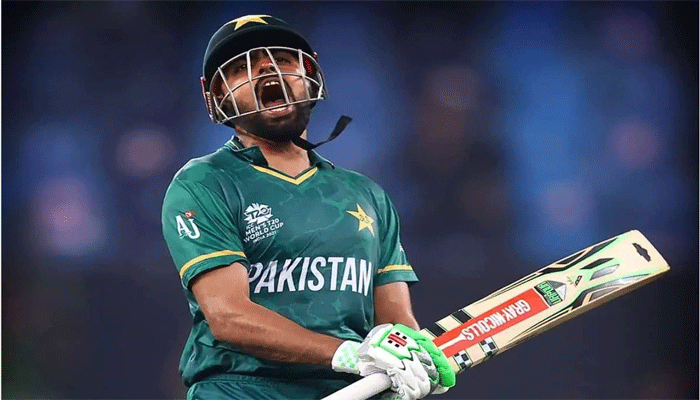
In a country where cricket is not merely a sport but a national obsession that borders on a religious experience, the weight of a cricketer’s bat can often feel heavier than anywhere else on earth. Generations have risen and fallen under the intense spotlight of Pakistani cricket, yet every few decades, a player emerges who doesn’t just play the game but redefines it for his era. For the 2020s, that player is Mohammad Babar Azam.
When you watch Babar Azam bat at the crease, there is an immediate sense of calm that washes over the stadium. In a nation historically known for its mercurial pace bowlers and unpredictable flair, Babar represents something different: consistency. He is the architect of innings, a painter who uses the canvas of the cricket field to create masterpieces with the delicate brushstroke of his bat. From the narrow, bustling streets near the Gaddafi Stadium in Lahore to the hallowed grounds of Lord’s, Melbourne, and Karachi, his journey is a testament to the idea that class is permanent.
But who is the man behind the cover drives? How did a shy kid from Lahore, carrying the genes of the famous Akmal cricketing clan, transform into the only Pakistani captain to lead his side to the number one ranking in ODI cricket? This deep dive explores the phenomenon of Babar Azam, dissecting his technique, his triumphs, the inevitable controversies, and the legacy he is building as one of the finest batters to ever represent Pakistan.
The Roots: A Lahore Boy with a Dream
To understand the discipline in Babar Azam’s batting, one must look at the environment he was born into. He entered the world on October 15, 1994, in Lahore, Punjab, into a Punjabi Kamboh family. His father, Mohammad Azam Siddiqui, ran a small watch repair shop, a humble business that instilled in young Babar the values of patience and precision—traits that would later define his cricketing technique .
However, the biggest cricketing influence in his life was right next door. Babar is the first cousin of two of Pakistan’s most explosive, if enigmatic, cricketers: Kamran Akmal and Umar Akmal. Growing up, he wasn’t just watching international stars on television; he was watching his cousins live the dream. They were the reason he fell in love with the sport, and their stories of dressing room banter and big matches inspired him to pick up the bat professionally .
Before he was a professional, he was a fan. As a child, Babar would sneak into the Gaddafi Stadium not as a player, but as a ball boy. From the boundary lines, he would watch the greats of the game, absorbing the atmosphere and visualizing himself on that very pitch . It was here that he sought guidance from his first coach, Rana Sadiq, who hammered the fundamentals of batting into him. While his cousins were known for their aggressive, sometimes impulsive stroke play, Babar was learning the art of building an innings—a foundation that would soon see him rise through the ranks of Pakistan’s Under-19 setup and domestic cricket.
The Dawn of an International Career
The international stage can be a daunting place for any young cricketer, but when Babar Azam walked out for his ODI debut on May 31, 2015, against Zimbabwe, he looked like he belonged. It was a modest beginning in the context of the series, but his knock of 54 runs off 60 balls was a statement . It wasn’t just the runs; it was the way he accumulated them. There was no panic, no wild slogs—just pure, text-book cricket.
Yet, the cricketing world truly sat up and took notice during the home series against the West Indies in 2016. In a remarkable display of consistency and dominance, Babar Azam scored three centuries in three consecutive matches. He became the first batsman in history to score 350+ runs in a three-match ODI series, with scores of 120, 123, and 117 . It was a coming-of-age moment. He wasn’t just a prospect anymore; he was a record-breaking phenomenon.
His rise in the shorter formats was meteoric. In January 2017, during the fifth ODI against Australia, he scored a magnificent century. This wasn’t just any hundred; it was only the second century ever scored by a Pakistani batsman in Australia since Zaheer Abbas achieved the feat in 1981 . He was fast-tracked into the Test side, making his red-ball debut against the West Indies in Dubai, where he scored a fluent 69. He was the first player to score a fifty on his Test debut in a day-night match .
The Champions Trophy Triumph
No discussion about Babar Azam is complete without mentioning the high point of Pakistan cricket in the last decade: the 2017 ICC Champions Trophy. While the final against India was defined by Fakhar Zaman’s luck-laden century and the pace of Mohammad Amir, Babar’s role was crucial. In the high-pressure final at The Oval, with the nation’s hopes resting on every delivery, he contributed a steady 46 off 52 balls . It was a supporting act, but a vital one in a run chase that could have easily crumbled under the weight of an India-Pakistan final. He returned home with a winner’s medal, solidifying his place as the future backbone of the team.
The Art of Batting: A Technical Masterclass
If you were to open a coaching manual for “How to Bat in the Modern Era,” there is a high chance the images would be of Babar Azam. His technique is often described as “copybook” or “picture-perfect.” Unlike some of his contemporaries who rely on raw power, Babar relies on timing and geometry.
His signature shot is undoubtedly the cover drive. He has a high elbow, minimal foot movement (just enough to get to the pitch of the ball), and a follow-through that suggests he has all the time in the world. It is a shot that has drawn inevitable comparisons with the great Virat Kohli and, before him, the legendary Sachin Tendulkar. But Babar’s game is not limited to just the off-side. Over the years, he has developed a prolific ability to flick the ball off his pads through the mid-wicket region, and he possesses a surprisingly effective pull shot for a batter of his build.
His biggest strength, however, is his adaptability. In T20 cricket, he can be the anchor, while in ODIs, he can accelerate seamlessly. For a long time, this adaptability was his superpower, allowing Pakistan to build innings around him.
The Captaincy Chronicles: Triumphs and Turmoil
Leadership in Pakistan cricket is often referred to as the “hot seat.” It is a position that has chewed up and spat out some of the country’s finest talents. Babar Azam’s tenure as captain was a rollercoaster of historic highs and crushing lows.
He assumed the leadership across all formats during a turbulent time, and for a while, he seemed to thrive on it. His crowning achievement as a leader came when he guided Pakistan to the number one ranking in ODI cricket, a feat no other Pakistani captain had managed . He also led the side to the semi-finals of the T20 World Cup in 2021 and the final in 2022. On the surface, the win-loss records looked impressive—he remains Pakistan’s most-capped T20I captain with 48 wins in 85 matches .
However, the criticism was always lingering. After a disappointing 2023 ICC World Cup campaign, the pressure became unbearable, and he stepped down from the captaincy. In a dramatic twist typical of PCB politics, he was reinstated as white-ball captain in 2024, only to be removed again after a lackluster T20 World Cup later that year .
The Leadership Debate
Was Babar Azam a good captain, or was he just a good batter who happened to be captain? This question has divided fans and experts. Former Pakistan captain Salman Butt offered a candid assessment, arguing that Pakistan’s progress to finals under Babar wasn’t due to his tactical genius. Butt pointed to external factors, like South Africa losing to the Netherlands in the 2022 T20 World Cup, which inadvertently paved Pakistan’s way to the final .
“Butt was asked whether Babar was a born leader,” and his response was clear: “I don’t think so.” He suggested that true leaders have their backups ready and make instinctive calls on the field, rather than relying solely on data sheets . This highlights the central tension of Babar’s captaincy: a man of few words leading a team of high emotions. While he led by example with the bat, the tactical captaincy often seemed reactive rather than proactive.
The Kohli Comparisons and the “Support System” Question
For the better part of a decade, the cricket world was obsessed with one debate: Virat Kohli vs. Babar Azam. The numbers were eerily similar. The cover drives were comparable. Both were chasing runs and records at a pace that left their peers in the dust.
However, as time has passed, the trajectories of the two stars have diverged, leading to a more nuanced discussion about the ecosystem around a player. Azam Khan, Babar’s Pakistan teammate, raised a fascinating point recently. While Kohli broke into the Indian team surrounded by the likes of Sachin Tendulkar, Rahul Dravid, VVS Laxman, and MS Dhoni, who was around Babar? .
“Virat Kohli had someone around him who was a legend at that time… So many big batters. But who was there with Babar? There was no one,” Azam Khan argued . This is a crucial observation. Babar Azam carried the burden of the batting lineup without the luxury of a dressing room full of mentors. The pressure on him was not just to score runs, but to be the sole custodian of the batting culture. While Kohli could learn from legends in his formative years, Babar was often the one expected to be the legend from day one.
The Form Slump and the Critics’ Corner
If the period from 2016 to 2022 was the golden era of Babar Azam, the years following have been a test of his character. Since 2023, the runs have dried up by his lofty standards. He hasn’t scored a Test century since 2022, and his ODI average, once flirting with 60, has seen a noticeable dip .
The criticism has reached a fever pitch, particularly surrounding his strike rate in T20 cricket. During the T20 World Cup 2026, the stats made for grim reading. Among players with over 500 runs in T20 World Cup history, Babar Azam’s strike rate of 111.81 was the lowest . In practice sessions, he looked fluent and authoritative, but in matches, that freedom seemed to vanish, replaced by a cautious approach .
Experts like Shoaib Akhtar have been scathing, stating that Pakistan created a “superstar out of a player who cannot win you a game” . Shahid Afridi went as far as to say he wouldn’t pick Babar, Shadab, or Shaheen again, claiming they had “failed” despite having plenty of chances .
A Deeper Dive into the ODI Struggles
To simply blame “lack of intent” is reductive. A detailed analysis of his ODI game since 2023 reveals a more technical problem. Until 2022, Babar averaged 59.8 at a strike rate of 89.7. Since 2023, that average has dropped to 45.1, and the strike rate to 82.5 . The issue isn’t just about hitting boundaries; it’s about the loss of his superpower: strike rotation.
In the middle overs, where running between the wickets is key, his “non-boundary strike rate” has plummeted to historically low levels . He seems to be scoring where the bowler allows him to, rather than manipulating the field. Against spin, he has struggled to access the off-side, becoming overly reliant on the leg-side. This technical stagnation, combined with the mental toll of captaincy changes and public scrutiny, has created the perfect storm of poor form .
Personal Life and Public Persona
Off the field, Babar Azam is known for being intensely private. Standing at 5 feet 11 inches, he cuts a stylish figure, but he rarely lets the public into his inner world . He has often been linked with actresses like Hania Aamir, but he has consistently denied any romantic link-ups.
Recently, his personal life has become a topic of public speculation, with rumors suggesting a disagreement with his family over marriage. Reports claim his parents wish for him to marry a cousin, while Babar reportedly has someone else in mind . Pakistan journalist Shahid Hashmi speculated that this “mental stress” might be contributing to his poor form, causing him to play loose shots .
While these remain rumors, they highlight the immense pressure Pakistani cricketers face—not just from the media and fans, but from the intersection of family expectations and public life. For a player like Babar, who carries the nation’s hopes on his shoulders, maintaining mental peace is just as important as physical fitness.
Legacy: Stats Don’t Lie
Despite the recent criticism and the intense debates about his captaincy or strike rate, one fact remains undeniable: Babar Azam is statistically the best Pakistani batter of his generation, and arguably of all time when compared at the same age.
At the age of 31, a comparison with Pakistan’s legends is staggering. While Inzamam-ul-Haq, Javed Miandad, and Mohammad Yousuf were all world-class players, their run tally at 31 was significantly lower than Babar’s. With over 15,400 international runs and 32 centuries, he sits at the top of the pile for Pakistani batters at this stage of their careers . He has 20 ODI centuries and is closing in on records that were once thought untouchable.
He remains the only captain to take Pakistan to the number 1 ODI rankings. He is the fastest to 1,000 runs in ODIs for Pakistan at the time, and he holds the record for the most T20I fifties (36) . These are not the numbers of a player who is “finished”; they are the numbers of a player navigating a rough patch in a long and storied career.
| Player | Total International Runs (at Age 31) | Total 100s (at Age 31) |
|---|---|---|
| Babar Azam | ~15,438 | 32 |
| Inzamam-ul-Haq | ~12,800 | 22 |
| Javed Miandad | ~11,500 | 20 |
| Mohammad Yousuf | ~10,500 | 21 |
| Table: A statistical comparison of Babar Azam with Pakistani legends at the age of 31 demonstrates his phenomenal run-scoring consistency . |
The Road Ahead: Redemption or Decline?
As of 2026, Babar Azam finds himself at a crossroads. He is no longer the captain, which could be a blessing in disguise. Freed from the tactical burdens, he has the chance to do what he does best: simply bat. The T20 World Cup 2026 has been tough, but the game of cricket has a funny way of rewarding the talented.
The question is whether he can adapt. Modern T20 cricket demands power and strike rotation. Can he add a new gear to his game without losing his natural elegance? Can he find a way to dominate spin in the middle overs again? His innings in domestic leagues and international cricket over the next year will define whether he finishes his career as a “what if” or as the undisputed king who conquered his only weakness: the expectations of a billion hearts.
In a heartfelt letter to The Express Tribune, a fan wrote, “Not every hero wears a cape. Today Babar Azam reminded us of leadership that isn’t defined by a title… His influence doesn’t come from an armband, it comes from the way he plays when it matters the most” . This is the hope that Pakistani fans cling to. They are waiting, patiently, for their hero to find his cape once more.
Frequently Asked Questions
What is Babar Azam’s highest score in international cricket?
Babar Azam’s highest score in international cricket is 266 runs, which he achieved in Test matches. In One Day Internationals (ODIs), his best is 158, and in T20Is, his highest score is an unbeaten 122 .
How old is Babar Azam and what is his height?
Babar Azam was born on October 15, 1994, which makes him 31 years old as of 2026. He stands at a height of 5 feet 11 inches (180 cm), although some sources list him slightly taller at 6 feet (183 cm) .
Why is Babar Azam often compared to Virat Kohli?
The comparison stems from their similar roles as premier top-order batsmen for their respective nations (Pakistan and India), their “copybook” batting techniques, especially the cover drive, and their incredible consistency in run-scoring across all formats. Both have been ranked as the number one ODI batsman in the world and have carried the hopes of billions of fans.
Has Babar Azam won any ICC trophies?
Yes, Babar Azam was a member of the Pakistan national team that won the iconic 2017 ICC Champions Trophy, defeating India in the final . While he has led Pakistan to the number 1 ranking in ODIs and the final of the T20 World Cup as captain, the Champions Trophy remains his only ICC trophy to date.
What is the controversy surrounding Babar Azam’s marriage?
Recent reports and speculation from Pakistani journalists suggest that Babar Azam is facing family pressure regarding his marriage. It is rumored that his parents want him to marry a cousin, while he reportedly wishes to marry someone else. This has led to speculation about mental stress affecting his on-field performance, though these remain unconfirmed reports .
Why is Babar Azam criticized despite scoring runs?
The primary criticism, especially in T20 cricket, revolves around his strike rate. Critics argue that while he scores runs, he consumes too many balls, which puts pressure on his partners. In the T20 World Cup 2026, his strike rate was the lowest among batters with over 500 runs in the tournament’s history, sparking a debate about his “intent” and adaptability to modern T20 demands .
Is Babar Azam related to Kamran and Umar Akmal?
Yes, Babar Azam is the first cousin of Kamran Akmal and Umar Akmal. Their fathers are brothers. Growing up, Babar was inspired by his older cousins’ careers in cricket .
Conclusion
Babar Azam’s journey is a mirror reflecting the passion, pressure, and unpredictability of Pakistani cricket. From the quiet lanes of Lahore to the roaring stadiums of the world, he has carried the hopes of a nation with a grace that belies his age. He has broken records that stood for decades and has built a body of work that statistically outshines the legends who came before him. Yet, in the unforgiving arena of modern sport, a player is only as good as his last innings. The debates about his strike rate and his captaincy will rage on, fueled by a fanbase that demands nothing less than perfection. But if there is one thing Babar Azam has proven time and time again, it is that class is permanent. As he navigates the twilight of his peak years, the world waits to see if he can silence his critics not with words, but with the timeless sound of bat meeting ball, driving it through the covers for four. His story is far from over; in many ways, the most compelling chapter may yet be unwritten.