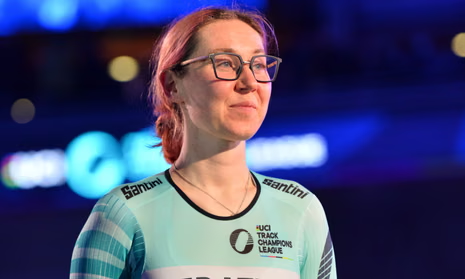
If you followed track cycling over the last decade, you know the name well. If you don’t, you are about to learn why the world of sports is currently buzzing. Katie Archibald isn’t just a cyclist; she is a statistical anomaly. In an era of British cycling dominance that followed the footsteps of icons like Sir Chris Hoy and Laura Kenny, Archibald carved out a niche as the ultimate gritty competitor. She was the rider who seemed to thrive in the chaos of the Madison, the relentless pace of the Omnium, and the technical precision of the Team Pursuit.
But in May 2026, the sports world received news that felt like a punch to the gut, even for those who saw it coming. Archibald announced her retirement from professional cycling, stepping away just as she was selected for the Commonwealth Games. It wasn’t a decision born of burnout or a lack of medals. Instead, it was something far more unexpected and refreshingly human: she fell in love with nursing. This article dives deep into the career, the statistics, the heartbreaking setbacks, and the beautiful reason Katie Archibald decided to hang up her helmet for a stethoscope.
The Late Bloomer Who Dominated the Velodrome
You often hear stories of athletes who are put on a bike before they can walk. Katie Archibald had a different origin story. Surprisingly, she was a relative latecomer to elite sport. She didn’t join the Great Britain Cycling Team’s endurance squad until she was 19. That is ancient by the standards of most Olympic development programs. However, this late start might be exactly what gave her such a grounded perspective.
Before her fame, she was just a Scottish lass enjoying grass track racing. There was no pressure of being a “child prodigy.” When she finally got the call to join the squad in Manchester, she brought with her a raw, untamed power that formal systems don’t always teach. On her senior competitive debut, she didn’t just “do okay”—she won the European team pursuit title. Riding alongside legends like Laura Kenny and Elinor Barker, she proved instantly that she belonged. From that moment, the trajectory was clear: Katie Archibald was built for the big stage, not as a future star, but as an immediate contender.
Breaking Down the Numbers: A Medal Machine
To truly understand the scale of this athlete, you have to look at the spreadsheet. Over a thirteen-year career, she amassed a staggering fifty-one medals across the Olympics, World Championships, Commonwealth Games, and European Championships. That isn’t just consistency; that is a reign of terror over the competition.
While many specialize in one or two events, Archibald was a utility player. She could win the grueling endurance of the Individual Pursuit, the sprint-finish madness of the Scratch Race, and the tactical chess match of the Madison. Specifically, her haul includes two Olympic golds, a silver, seven world titles, and a record-breaking twenty-one European titles. Yes, you read that right. Twenty-one European golds. That number alone makes Katie Archibald the most decorated European track cyclist of all time. She didn’t just beat her rivals; she made them play for silver.
Scotland’s Greatest Export on Two Wheels
There is a fierce pride that comes with the Scottish cycling community. While Sir Chris Hoy is the undisputed king of sprinting, the endurance crown belongs to Katie Archibald. She represented Scotland with a ferocity that was palpable every time she wore the blue jersey.
Her relationship with the Commonwealth Games was a love story that spanned years. It started with a bronze in the Points Race at Glasgow 2014, a moment she describes as transformative. By the time the Gold Coast 2018 rolled around, she had evolved into a gold medalist, winning the Individual Pursuit. It is a tragic irony, then, that her career ended with her on the team sheet for Glasgow 2026. The draw of the “real world” was simply too strong. To voluntarily walk away from a home Games when you are still a world champion takes incredible guts—or a calling that transcends sport.
The Legend of the Madison Gold in Tokyo
If you ask a casual fan to recall one image of Katie Archibald, it is likely the sight of her and Laura Kenny dominating the Madison at the delayed Tokyo 2020 Olympics. This event was historic: it was the first time women were allowed to compete in the Madison at the Olympics. And Archibald made sure history remembered her.
The Madison is a chaotic event. It involves tag-outs, slingshots, and laps where riders rest on the apron. It requires absolute trust. The partnership between Kenny and Archibald was a masterpiece of synergy. While Kenny brought the explosive match sprint, Archibald brought the diesel engine. She lapped the field with her partner and secured the gold. For Katie Archibald, this medal wasn’t just hardware; it was validation. She had been one of the loudest voices lobbying for women to be allowed to race in this discipline. To then win the inaugural title was poetic justice.
The Devastating Garden Accident That Derailed Paris
To truly appreciate the strength of her retirement decision, we have to rewind to the cruelest moment of her career. Most athletes miss the Olympics because of a rival who is faster or a bad crash in competition. Katie Archibald missed the Paris 2024 Olympics because of a step in her garden.
Just weeks before the Games, she tripped. It was a freak, mundane accident that resulted in a dislocated ankle, broken tibia and fibula, and torn ligaments. In an instant, her third Olympics was gone. She described the surreal feeling of waking up from surgery, knowing she wasn’t going to Paris. For an athlete of her caliber, this was devastating. Yet, true to form, she didn’t wallow for long. She rehabbed with the focus of a woman possessed. By the end of 2024, she was back on the boards, winning World Championships gold. It was a testament to her resilience, proving that Katie Archibald was tougher than any broken bone.
Grief, Resilience, and Coming Back Stronger
The garden accident wasn’t the only tragedy that struck. In 2022, Archibald suffered a loss that would have broken most people. Her partner, mountain biker Rab Wardell, died suddenly from a cardiac arrest while lying next to her in bed. The trauma of that event is unimaginable.
She has spoken sparingly but honestly about the aftermath. She admitted to becoming “controlling” and “hard to work with” for a while, driven by an obsessive need to control her environment because her personal world had fallen apart. When asked how she kept racing, she channeled that grief into the bike. She credits Rab with teaching her that life is about chilling out and having fun—a lesson she is finally embracing in retirement. The fact that Katie Archibald won a World Championship in 2023, just a year after his death, while carrying that emotional weight, might be her most impressive victory of all.
| Her final major title announced a continued world-record pace. | Medal Achieved | Significance of the Moment |
|---|---|---|
| Rio 2016 Olympics | Gold (Team Pursuit) | First Olympic title; flawless execution with the GB squad. |
| Tokyo 2020 Olympics | Gold (Madison) | Inaugural women’s event; historic partnership with Laura Kenny. |
| World Championships 2023 | Gold (Team Pursuit) | Emotional home victory in Glasgow after a year of grief. |
| Commonwealth Games 2018 | Gold (Individual Pursuit) | Proved individual dominance against Commonwealth rivals. |
| European Championships 2025 | Gold (Team Pursuit) | Her final major title; announced continued world-record pace. |
The Surprising Move to Nursing School
So, why walk away while on top? Usually, athletes retire because their bodies give out. Katie Archibald retired because her heart found a new home. Last year, she enrolled as a nursing student at Glasgow Caledonian University. Initially, she tried to juggle both. She was racing at the World Tour level while studying anatomy. But the pull of the wards was stronger than the pull of the velodrome.
In interviews, she describes falling “completely in love with nursing.” She loves the trust patients place in her. She loves the anonymity. At the hospital, no one cares if she won an Olympic gold; they care if she can get the cannula in right. She revealed that one of her favorite moments was a lecturer telling her that cycling was a “nice hobby.” That sense of being ordinary is intoxicating for someone who has lived in the extraordinary pressure of elite sport for thirteen years.
Why She Retired Despite Glasgow 2026
It is important to stress that nursing was not forcing her out. Katie Archibald made it clear that she wasn’t failing her courses or flunking out of training. Instead, she described the “draw of the real world.” She admitted she was “scared to leave” for a long time. But eventually, the craving to live the life she had been “saving for a rainy day” became louder than the roar of the crowd.
Even though she was selected for Team Scotland for the 2026 Commonwealth Games in Glasgow—a home Games on her favorite track—she said no. She explains that her mind and body said, “It’s time for the next generation to shine.” For a rider as competitive as she is, that self-awareness is rare. She is leaving at a point where she still holds a world record and a European title. She isn’t retiring because she lost; she is retiring because she found something else to win at.
The Impact on British Cycling
The departure of Katie Archibald leaves a massive hole in the Great Britain Cycling Team. Performance Director Stephen Park has described her as “relentless.” She wasn’t just a medal winner; she was the vibesetter in the pursuit squad. Younger riders like Anna Morris and Josie Knight looked to her to learn how to handle pressure.
Her influence also changed the language of the sport. In a typically witty, self-deprecating manner, Archibald once joked that her legacy wasn’t the medals, but the fact that women in the GBCT now say “P1” instead of “Man 1” for the lead rider in the pursuit. That small, linguistic shift represents a massive cultural shift in women’s cycling. She wasn’t just racing; she was dismantling the boys’ club one pedal stroke at a time.
A Day in the Life: From Podium to Patient Care
You have to wonder what a typical Tuesday looks like for a retired Olympian who is now a student nurse. For Katie Archibald, it is a jarring but welcome contrast. One year ago, she was sleeping in altitude tents and measuring her calorie output to the gram. Today, she is likely making beds, taking vitals, and doing the gritty, glorious work of the NHS.
This transition is not common. Most athletes become coaches or pundits. Archibald chose a profession known for burnout and low pay. But for her, the emotional reward is the point. She has spoken about how special it feels to be someone people trust when they are vulnerable. It requires the same empathy and emotional intelligence she showed grieving teammates after Wardell’s death. It is the same resilience, just applied to a different scoreboard.
Quotes That Define a Champion
Katie Archibald has always been refreshingly honest with the media. She doesn’t give robotic, PR-approved answers. Here are some of her most defining quotes that capture her spirit:
- On Retirement: “The draw of the ‘real world’ has been pulling me for a while, but I’ve been too scared to leave the world I know and love.”
- On Her Injury: “I tripped over a step in the garden and managed to, somehow, dislocate my ankle, break my tibia and fibula, and rip two ligaments off the bone. What the heck.”
- On Nursing: “It feels so special being someone people can trust when they need help.”
- On Her Legacy: “I’m not hoping for a grand legacy, but I hope I’ve made an impact on the individuals I’ve worked with.”
- On Rab Wardell: “Thank you to Rab, who taught me that very few things in life are more important than chilling out and having fun.”
Embracing Anonymity and the Future
One of the most charming revelations from Katie Archibald in her final year of racing was how much she loved being anonymous at university. She walked the halls of Glasgow Caledonian University without anyone recognizing her. To her peers, she wasn’t “Olympic champion Katie”; she was just “Katie, who is good at the theory but tired on placement days.”
She has been careful to step back from the public eye. Part of the trust required in nursing is confidentiality, and she is keen to protect that. She doesn’t want a patient to recognize her from the podium and feel uncomfortable. As she hangs up her helmet, she is trading the roar of the velodrome for the beep of the heart monitor—and she couldn’t be happier.
Conclusion
The story of Katie Archibald is not a tragedy, nor is it merely a sports recap. It is a story about agency. In an industry that chews up athletes and spits them out, Archibald walked away on her own terms, at the peak of her powers, with a world record around her neck and a nursing badge in her pocket. She survived grief that would have crushed a spirit, she rebuilt a body that doctors said was broken, and she looked at a home Commonwealth Games and said, “I have something better to do.”
We will miss the legs on the bike. We will miss the tactical genius in the Madison. But perhaps the greatest gift Katie gave us is the permission to change, to grow, and to find joy outside of the identity we have built for ourselves. Scotland has lost a cycling legend, but the NHS is gaining a guardian angel.
Frequently Asked Questions
Why did Katie Archibald retire from cycling?
Katie Archibald retired primarily because she “fell in love” with nursing. While training as a student nurse, the draw of the “real world” and a desire to help people in a medical capacity outweighed her desire to continue training for elite competition. She stated she was no longer scared to leave the sport she loved.
What was Katie Archibald’s most serious injury?
Her most devastating injury occurred just weeks before the Paris 2024 Olympics. In a freak gardening accident, she tripped over a step, resulting in a dislocated ankle, a broken tibia and fibula, and torn ligaments. The injury forced her to miss the Games entirely.
How many Olympic medals does Katie Archibald have?
Katie Archibald has three Olympic medals. She won gold in the Team Pursuit at Rio 2016, and at the Tokyo 2020 (held in 2021) she won gold in the inaugural Women’s Madison and silver in the Team Pursuit.
Is Katie Archibald still a world record holder?
Yes, as of her retirement announcement, Katie Archibald remains a current world champion and is part of the women’s team pursuit squad that holds the world record. She won the team pursuit title at the 2025 European Championships and the 2024 World Championships.
What is Katie Archibald doing now in 2026?
In 2026, Katie Archibald has fully retired from professional cycling to focus on her career as a nurse. She is a nursing student at Glasgow Caledonian University and has stepped away from the Great Britain Cycling Team and the Commonwealth Games to pursue this new vocation.